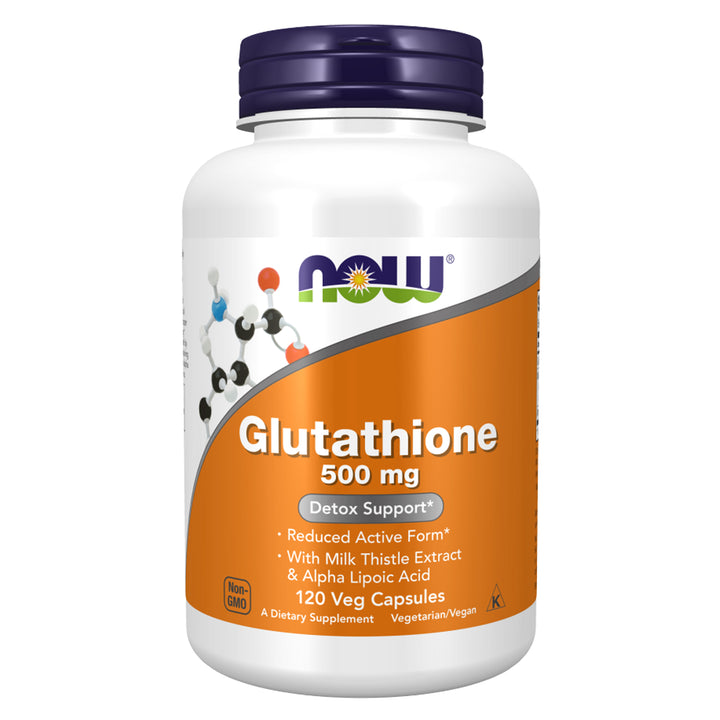
Glutathione (L-Glutathione, GSH) is a tripeptide antioxidant composed of three amino acids — cysteine, glycine, and glutamic acid — synthesised primarily in the liver and present in virtually every cell of the human body.
Glutathione is the most abundant endogenous antioxidant in human cells. Its core biochemical roles include neutralising reactive oxygen species (free radicals), recycling vitamins C and E back to their active forms, and supporting hepatic phase II conjugation reactions. GSH levels decline with age, chronic oxidative stress, poor nutrition, and alcohol exposure.
Key Facts — Glutathione Ireland
-
What it is: Tripeptide (cysteine + glycine + glutamic acid) — the body's most abundant endogenous antioxidant
-
Primary synthesis site: Liver — distributed to all tissues via blood
-
Dietary sources: Broccoli, kale, garlic, onions, avocado, asparagus, whey protein
-
Oral absorption: Human RCT data confirms oral GSH at 250–1,000 mg/day raises blood glutathione levels (Richie et al., Eur J Nutr, 2014, PMID 24791752)
-
Typical trial dose: 250–1,000 mg/day in human trials; 500 mg/day most commonly studied
-
Age-related decline: GSH levels fall approximately 10–15% per decade after age 45 (Sekhar et al., Am J Clin Nutr, 2011, PMID 21795440)
-
Vegan suitable: Yes — in HPMC veggie capsule format
-
Irish regulatory status: Food supplement regulated by FSAI — not a medicine
-
Irish VAT on supplements: 13.5%
Human Evidence — Key Study
Richie et al. (Penn State Cancer Institute, Eur J Nutr, 2015;54(2):251-263, PMID 24791752) — 6-month randomised, double-blind, placebo-controlled trial in 54 healthy adults. Oral glutathione at 250 mg/day and 1,000 mg/day both significantly raised blood GSH versus placebo at 1, 3, and 6 months. High-dose group: 30–35% increase in erythrocytes and lymphocytes, 260% in buccal mucosal cells (p<0.05). This challenges the long-held assumption that oral glutathione is fully degraded before absorption. The study does not establish specific clinical outcomes in healthy adults — that translation requires further RCT evidence.
Forms of Glutathione
| Form |
Mechanism |
Human Evidence |
| Reduced L-Glutathione (GSH) |
Direct supplementation of the biologically active form |
Best-studied — Richie et al. RCT (PMID 24791752) |
| Liposomal Glutathione |
Phospholipid encapsulation to improve gastric stability |
Some absorption data; no head-to-head RCT vs reduced GSH |
| S-Acetyl Glutathione (SAG) |
Acetyl group intended to resist gastric breakdown |
Limited comparative human RCT data |
| NAC (N-Acetyl Cysteine) |
Cysteine precursor — supports endogenous GSH synthesis |
Extensive clinical literature; indirect approach |
Glutathione vs NAC — Key Difference
Glutathione supplements supply GSH directly. NAC (N-acetyl cysteine) supplies cysteine — the rate-limiting amino acid in endogenous glutathione synthesis — allowing the body to produce more GSH itself. Both approaches have human evidence; NAC has a longer clinical track record. Neither is definitively superior for healthy adults.
Liposomal vs Reduced Glutathione
Liposomal glutathione uses phospholipid encapsulation to protect glutathione from gastric degradation. Reduced L-glutathione is the active form used in the Richie et al. RCT. No head-to-head RCT has established that liposomal forms produce better clinical outcomes than quality reduced L-glutathione at equivalent doses. Liposomal forms are typically higher cost.
Glutathione and Skin — What the Evidence Shows
Some human trials report modest, temporary reductions in melanin index (a measure of skin pigmentation) with oral glutathione at 500 mg/day. A systematic review by Watanabe et al. (J Dermatolog Treat, 2020, PMID 30895708) found effects in sun-exposed skin areas in Asian populations (Fitzpatrick types IV–VI). Effects were not observed in sun-protected areas, were temporary after cessation, and were variable between studies. Most Irish consumers have Fitzpatrick skin types I–III — the direct relevance of this evidence to Irish users is not established. No authorised EU health claim exists for glutathione and skin.
Glutathione and Liver — What the Evidence Shows
Glutathione is biochemically central to hepatic phase II conjugation reactions. In a pilot study, Honda et al. (BMC Gastroenterol, 2017, PMC5548760) found 300 mg/day oral glutathione reduced ALT markers in 29 NAFLD patients over 4 months — but this was a clinical population without a control group. The claim that glutathione supplements "detox" a healthy liver is not supported by controlled RCT evidence in healthy adults.
Dosage and Timing
Human trials have used 250–1,000 mg/day. The most commonly studied dose for general antioxidant and skin purposes is 500 mg/day. Taking glutathione on an empty stomach may improve absorption of this amino acid-based compound. Vitamin C co-administration is common — vitamin C regenerates oxidised glutathione back to its active form, and the two compounds work synergistically in the antioxidant cycle. Consistent daily use for 4–8 weeks is typically required before measurable blood GSH changes occur (Richie et al., PMID 24791752).
Safety Note
Oral glutathione at 250–1,000 mg/day for up to 6 months has a good safety profile in published trials. Mild GI effects (flatulence, loose stools) have been reported and typically self-resolve. Avoid during pregnancy and breastfeeding. Individuals with asthma should avoid inhaled forms. Intravenous (IV) glutathione carries significantly higher risks (anaphylaxis) than oral supplementation — these are entirely different risk profiles. Consult a GP before use if on medication or if you have a health condition.
Irish Regulatory Status
Glutathione supplements are regulated in Ireland by the Food Safety Authority of Ireland (FSAI) as food supplements under national food supplement legislation and EU Regulation 1925/2006. Glutathione is not classified as a medicine by the HPRA and requires no prescription. No authorised EU health claim under Regulation 1924/2006 currently exists for glutathione — this page summarises published human research only and does not make health claims for any product. Irish VAT on food supplements is 13.5%.
Evidence references: Richie JP Jr et al. Eur J Nutr. 2015;54(2):251-263. PMID 24791752 · Watanabe F et al. J Dermatolog Treat. 2020;31(8):824-831. PMID 30895708 · Honda Y et al. BMC Gastroenterol. 2017;17(1):96. PMC5548760 · Sekhar RV et al. Am J Clin Nutr. 2011;94(3):847-853. PMID 21795440 · FSAI food supplement guidelines: fsai.ie